Monday, December 2, 2019

SKETCHING: An Art To Convey Emotions


Sketching is an art by which an artist draw his/her feeling and convey his/her message to public or desired one. It has strong as well as long term effects … but to touch exact meaning and feelings of a sketch is also not an easy job.
Behzad Ahmad


Emotion is something that has a strong feeling deriving from one's circumstances, mood, or relationships with others. There are six basic emotions in human, Anger, Disgust, Fear, Happiness, Sadness, and Surprise.
Human facial expressions are one of the most important non-verbal ways we communicate. With 43 different muscles, our faces are capable of making more than 10,000 expressions, many of them tracing back to our primitive roots. Even our smile, some researchers say, evolved from the way primates show off their teeth to negotiate social status or to establish dominance.
In contrast, Feelings play a big role in communication. Emotional awareness, or the ability to understand feelings, will help you succeed when communicating with other people. If you are emotionally aware, you will communicate better. You will notice the emotions of other people, and how the way they are feeling influences the way they communicate. You will also better understand what others are communicating to you and why. Sometimes, understanding how a person is communicating with you is more important than what is actually being said.
Have you ever tried to hide your feelings? It’s pretty hard for most of us to do. That’s because emotions don’t lie. Instead of trying to hide or ignore your feelings, focus on becoming aware of your feelings and the feelings of those around you in order to be a better communicator.
Moreover, There is various ways to convey emotions to other, some people convey there emotions through verbal communication like face to face communication, or in written form and some use non-verbal communication. Emotions can also conveyed by some arts, like music and drawing etc.
Furthermore, Every artist has there own “thing” they work on. That aspect of their art that eludes them.  It changes from time to time depending upon what season of their art journey they are in.  With this particular piece, I was working on expressing emotion in my drawing. It is something I have been struggling with. To get the emotions not only in the lines of the facial features, but in the overall feel of the piece. Drawing on your own experiences when creating a piece can help you express feelings in your drawing. Our work often follows whatever mood we are in while working on it.
Drawing a happy, lighthearted scene while thinking of a very bad time in your life will confuse the viewer. Your strong negative emotions will come across in your drawing. That is not to say you have to always feel the emotions of your subject. Just be aware of the fact the emotions can transfer to your work. This is true for painting, drawing, writing or any form of art. Art is truly an expression of our inner turmoil or pleasure.
Moreover, Adding a backstory to your piece can add to the viewers emotional experience. Drawing an old abandoned house can evoke emotions in and of itself. Adding a battered and worn child’s toy, abandoned on the front step, can ramp up the emotions of the piece.
It is no longer a drawing of a dilapidated building, but a home that once had life. It leaves the viewer wondering what happened to the family and maybe feeling a little nostalgic for their own childhood. Emotions in figure drawing can be shown in more than just facial expression. Body language is also important. The posture of the subject can convey pain, sadness, dejection, joy or almost any emotion.
The face can be completely hidden and yet you can show how the person is feeling in that moment simply by how the figure is presented. You can draw someone with there shoulders hunched and hands hidden in there face and it will show sadness or despair.
At the end, I would like to tell you that creating a piece of art can be more than just painting or drawing a pretty piece intended for sale. Art can be a way to express your feelings, deal with strong emotions and help you to de-stress. We are never fully satisfied with our work and are definitely our own worst critics. As with all things in life, we get closer to our idea of perfection with practice. The more you draw, the more you learn how to put life into the piece and how to express emotions in your drawing.

I hope you continue to draw every day and I know you and I both will get better with practice.

-Behzad Ahmad

A walk through the historic streets of Chakwal


Our guide is my granduncle who resides in the UK but visits his hometown every year, relishing in the simplicity of the place and reminiscing his childhood memories. PHOTO: TAYEBA BATOOL

We start our journey on foot from the doorways of our ancestral home on Allah Da’d street, located across from Sarpak (meaning ‘pure ground’ in Urdu). I visit Chakwal occassionally and we always spend a few days in this house, owned and originally built by my great-great-grandfather.

The baithak in the centre commands serenity and space, and brings all the members of the household together for communal dining and reminiscing of the past. The surrounding rooms have changed shape over the years and have adapted to modern day comforts, but the elders still remember how everything was originally, comprising of: a space to keep cows and hens, an open kitchen, and, a raised platform for prayer.

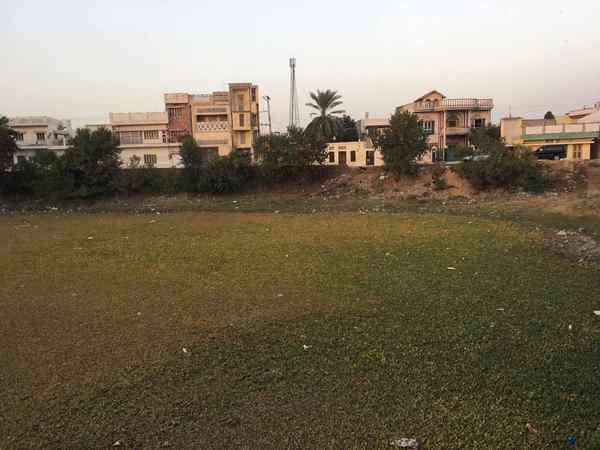
The real joy of visiting a place is always in what lies beyond the walls. We exit the gates to emerge onto the street, facing Sarpak. A few decades ago, this was a rain-filled pit that had water clean enough to bathe or wash clothes. Later, it became the bathing and resting ground for buffaloes before resigning to its present-day fate of being a garbage dump and algae colony.


Sarpak.

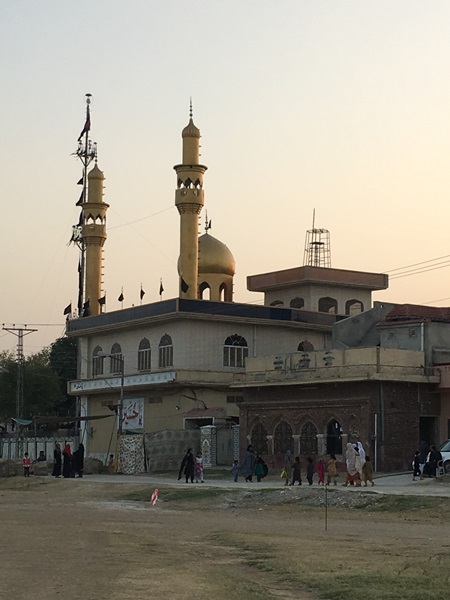
In contemporary times, Sarpak is most closely associated with the Markazi Imambargah close by, and the adjoining huge communal ground. This ground serves multiple functions, such as acting as a cricket ground, a football field, a car park, a shortcut for passing rickshaws and cars, a procession gathering spot (religious or political) and an open idle space to pass the time.


Markazi Imambargah.

Our guide is my granduncle who resides in the United Kingdom but visits his hometown every year, relishing in the simplicity of the place and reminiscing his childhood memories. His stories relate the transformations of the buildings, the town and the people who used to reside in this neighbourhood.

After crossing the now-metalled road, he quickly leads us onto the sheltered labyrinthine streets (or galliyan) of Chakwal’s oldest parts. The streets are barely wide enough for three people to walk side-by-side, yet motorcyclists pass by, barely breaking speed and almost always (miraculously) causing no harm.


Streets in the old parts of Chakwal.

Gravel and concrete have replaced the older mud paths and narrow water drains lie exposed on either side. The streets are narrow but take a 360-degree turn, and history appears to call out to us at each step.

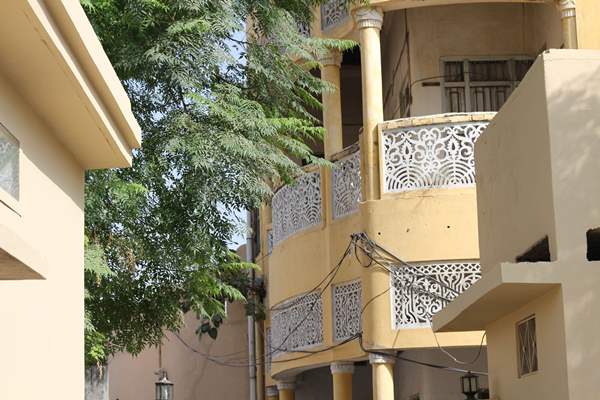
Traditional handcrafted wooden doorways are still in use, bringing alive the craftsmanship and naturalistic designs of yester-years. Overhead balconies (jharokas) and raised platforms outside the home (takhts) testify how once upon a time all neighbourhood gossip was delivered via evenings spent with neighbours.


‘Jali’ work on the balconies.

Arabesque lattice patterns, and arches on windows are yet another reminder of days gone by. I cannot help but notice the similarity here with some of the streets in the walled city of Lahore.

As we walk ahead, we notice that there are no name plates or numbers outside several houses. My granduncle points to multi-storey houses on the way, and relates generational stories of how families residing here, prospered or decayed.


“That is the kothi of the halwai (maker of halwa, which is a South Asian dessert). I met his son in the United Kingdom. One day, this fine, young gentleman comes to my office looking for me, and announces, without shame, that he was the son of the halwai in our neighbourhood. He has really helped his family back home.”

This is one of the many rags-to-riches stories to be encountered in this region. Several prominent businessmen, high ranking military personnel, and politicians can trace their roots to Chakwal – both the town and the villages within its judicial boundaries.

My granduncle also points out a marker on our path saying:


“Every year I visit, I always see trash dumped at this exact spot. Always. I don’t know why.”

The mound of plastic bags, food waste and fruit peels on the otherwise clean alley is an eyesore and is disturbing for the olfactory senses. The mystery of how it gathers here, who collects it and why it is not removed by the residents is still unresolved. Unfortunately, this menace of waste pollutes much of our interaction with the urban space.

A little further, we arrive at a tile clad wall and a dome structure, hinting that we were standing before a mosque.


“Can you guess how old this mosque is?”

Our guide eyes us eagerly, anticipating the ‘wow’ moment to come.


“Sometime around 1950?” I suggest.

“This is the oldest mosque in Chakwal, almost three centuries old,” he informs us.

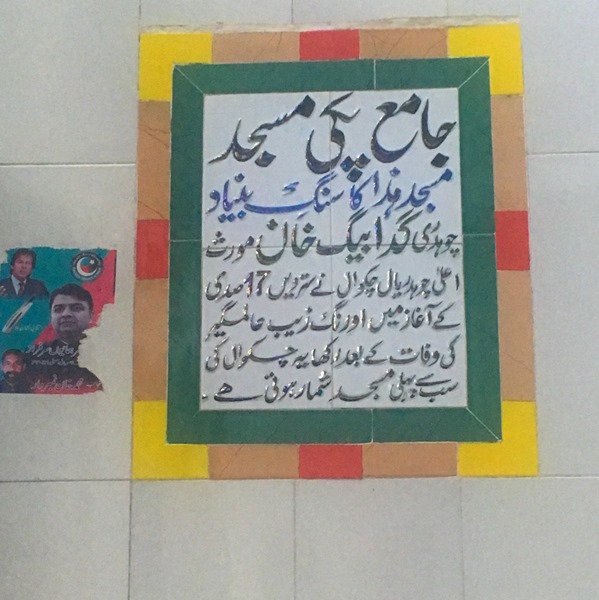
And we are, as he expected, awe-struck standing in front of the Paki Masjid. The mosque was established in the beginning of the 17th century, soon after the era of the last Mughal Emperor, Aurangzeb. The plaque on the wall also claims that a certain Chaudhary Guda Baig Khan laid the mosque’s foundation.


The oldest mosque in Chakwal.

After multiple turns through the residential quarters, we come out into Bhabra Bazaar, the market place. I can see stalls and carts selling fruits, vegetables, Chinese plastic toys, clothing items, and savoury snacks such as chana chaat, dahi bhallay, and french fries are lined up. Sound levels here have increased manifold. The traffic din from the main road further ahead, fills up the space, alongside the conversational Punjabi and the street hawkers loudly declaring goods for sale.

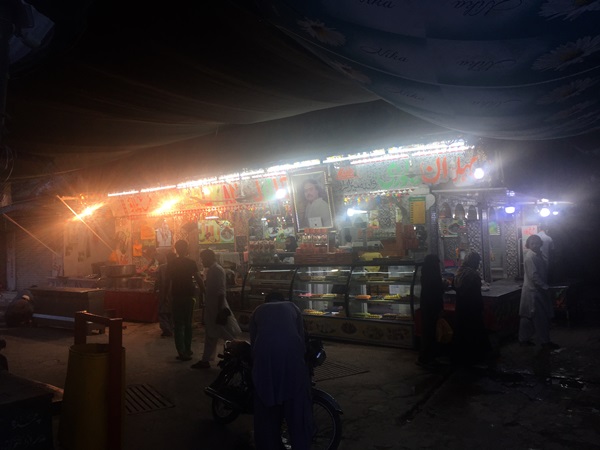
I also spot the Bab-e-Chakwal (Gate of Chakwal), a recently constructed monument, at the end of the line. I am struck by the confluence of the old and the new, and how it changes within just a matter of minutes and just a few feet. The hanging bulbs on the stalls are already lit. The brightest point, however, is the shop in the middle: Chakwal’s famous ‘Pehlwan Rewari’.


“This is the original and very first shop,” another long-time denizen of Chakwal tells me.

Multi-coloured fairy lights decorate the signboard, with the trademark photo of a man with a moustache (possibly the Pehlwan who started the business). The rewari (sweet candies traditionally made of ghee, gur and sesame seeds) is a speciality of Chakwal, as the sohan halwa is to Multan.


Chakwal’s famous ‘Pehlwan Rewari’.

Emerging onto the main Chakwal Road, I already feel nostalgic for the more intimate, accessible space we were walking through. Cars are now in sight, as are billboards, stretches of multi-storey buildings, and a big, grey road leading to (or coming from) a vast stretch of land. At a small flower market on the main road, my companions buy rose petals for their visit to the graveyard the next day.

We return via the Hospital Road, behind the District Hospital, which was established during colonial times. Passing by a traditional tandoor, we grab fresh, hot naans for the journey back. My granduncle introduces us to one of his class fellows, a fruit seller, who insists we take home a few oranges.

And that is how the walk through history ends – reaffirming bonds of friendship, memories and places, and a social fabric that keeps everyone together, even after so many years.

First the dam fund, now the ‘Lets Clean Karachi’ fund – what do we pay taxes for?


Two teenagers were riding a donkey cart full of garbage they had collected from houses towards a garbage dump located behind a ground known as Eid Gah in Karachi’s Gulberg Town. After reaching the spot, the boys emptied the garbage and the horrid smell forces passers-by’s to cover their noses.

Every month, representatives from a local governing body collect Rs100 from each house in Gulberg Town for the facilitation of garbage disposal. However, the waste material is neither disposed of nor is it recycled properly. Ultimately, no one knows where the money that had been collected from the pockets of the citizens is spent.

This is a common problem. Apart from a few affluent localities in Karachi, hordes of garbage are piled up across various neighbourhoods in the city and it has become apparent that the government has failed to devise an effective long-term strategy for Karachi’s garbage conundrum.

In an attempt to tackle this very problem, the Minister for Maritime Affairs Ali Haider Zaidi, a member of Pakistan Tehreek-e-Insaf (PTI), launched the ‘Let’s Clean Karachi’ drive, in collaboration with the Muttahida Qaumi Movement-Pakistan (MQM-P). The drive officially kicked off on Sunday at the Karachi Port Trust Office (KPT) and will reportedly be carried out in two phases. In the first phase, storm water drains will be cleaned while the second phase will comprise of clearing garbage from the streets and roads.

Thursday, November 28, 2019

Bint-E-Hawwa


I have no words to explain the glory of Allah almighty. He had created countless creatures from which one is human. The human who is being known as "Ashraf-ul-Makhluqat".

Allah has made human in two genders. One is male other one is female. But sad part is that man feels that other creature lesser than him. And restrain from basic rights. In the early age of the world Illiterat people burry the girl when she born.

World has reached to the destination of progress by the time but the sad part is the concept of killing and torturing the women is still the same. We can see many examples in our daily life. Now a days it is very common to keep away the women from her basic rights. And make her feel that she is weak.

Moreover, they think that women is just a machine and she was born just to give comfort to other and born babies. If a woman gives birth to a child she don’t even have the right to select her baby's name.  Only men can decide name and same it is with theor eduction. Where she will get married it is not asked from her, neither she's asked whether she's happy or not.

Her fate is written without her consent. In the form of a lady a wife leads her life like her own mother.
She has to fulfill all the orders and cycle goes on. Some lucky girls did not face these situations. 

We have to break this cruelty and follow the guideline of our "PROPHET(P-B-U-H)" and give proper rights to all women and make her strong instead making her weak. And she will support you in every field of your life.

-BEHZAD AHMAD